Showing posts with label OpenCL. Show all posts

Tuesday, June 21, 2011

PhD Proposal: University of Perpignan

Title: Real-­time implementations of power flow algorithms in the context of multiprocessor.

Keywords: Power-Flow analysis, electrical network, multiprocessor, High Performance Computing under constraint, OpenCL

Supervisor/contact: David Defour (david.defour'AT'univ-perp.fr)

Location: Perpignan/France Scientific

Context: Electrical network simulation monopolises considerable efforts in today's international community. Currently the networks are statically sized to the expected and projected demand and which is said to be completely accessible. The electrical network of the future, especially if one takes into account the needs of energy required by electrical vehicles, can no longer follow this model of full accessibility: indeed, vehicles' consumption will be highly correlated (peak hours - commuting between home and office in the mornings and evenings) and networks should be resized drastically to take these problems into account.

"Load flow" refers to the calculation of the distribution system according to the charges. If there are many projects or software for load flow simulation, none of them offer the performance to achieve a decent responsiveness. For example, in a given area, if 10 000 vehicles connect within 30 minutes, each vehicle would require a response within 20ms. This is not possible due to budget constraints as it would require the use of a supercomputer or a grid computer in every area that has to be considered (car park, city, region, ...).

Goal: The purpose of this thesis is to propose mechanisms that will lead to several implementations of the same algorithm regarding various objectives in the context of multicore architecture. As far as multicore architectures are concerned, improving performance is the main aim when developing applications such as the one presented above.

However new challenges need to be alleviated in order to achieve performance for a reasonable investment. These challenges can be represented by the trade-off between two conflicting goals. On one side, opacity is required to hide to the programmer unnecessary details about the hardware, the memory hierarchy and the communication network. On another side, visibility of the fundamental elements is necessary to let the programmer harness the power of today's multicore architectures.

However, additional constraints have to be taken into account. Among them, power consumption is nearly as important as performance. Usually the former is impacting the latter and vice versa. In this context, several implementations of the kernel should have to be considered depending on the targeted hardware or the workload of the architecture. This is kernel versioning.

The objectives of this thesis is to define a framework where it will be possible to extend the usual criteria that leads to multi-versioning with for example:
Hardware constraints: We are proposing to consider the usual constraints based on hardware characteristics, like memory, network interconnect and communication requirements of the application.
Context dependent constraints: For a given task several algorithms can be considered depending on the size of the data or the objectives to achieve (power, latency or bandwidth).
Regularity constraints: Regularity is essential when considering parallel applications. Depending on the architecture, we have to consider regularity on data structures, data values, execution or control.
Reliability constraints: Depending on the hardware, we may have a memory hierarchy with or without ECC. We may want to handle hardware errors that happen during computation by duplicating them either in time or in space according to the architecture.
Accuracy constraints: Multicore architectures make use of many floating-point units. These units implement the IEEE 754 standard, in which the 2008 revision introduces various representation formats, ranging from 16 to 128 bits. This encourages the adoption of mixed-precision in floating-point based algorithms.

Proposed implementations will be tested and validated by an industrial partner of this project.

Monday, June 20, 2011

Printing OpenCL binary...

I found this snippet (originally in C++) somewhere that I can't remember. Some changes to standard C and voilà how to write out your OpenCL program binary:


Just replace the cpProgram variable by yours. See below an example of result (NVidia PTX code):

Monday, June 13, 2011

OpenCL programs in Latex (listings package)

When we need to put some snippets of OpenCL in Latex documents usually we use C syntax definition for the listings package. I've added the definitions below to lstlang1.sty file(you can find it in the shared directory of your tex). Put this just after your C++ language definitions and before Objective C.

 \lst@definelanguage[OpenCL]{C}[ANSI]{C} 
{morekeywords={__kernel,kernel,__local,local,__global,global,%
__constant,constant,__private,private,%
char2,char3,char4,char8,char16,%
uchar2,uchar3,uchar4,uchar8,uchar16,%
short2,short3,short4,short8,short16,%
ushort2,ushort3,ushort4,ushort8,ushort16,%
int2,int3,int4,int8,int16,%
uint2,uint3,uint4,uint8,uint16,%
long2,long3,long4,long8,long16,%
ulong2,ulong3,ulong4,ulong8,ulong16,%
float2,float3,float4,float8,float16,%
image2d_t,image3d_t,sampler_t,event_t,%
bool2,bool3,bool4,bool8,bool16,%
half2,half3,half4,half8,half16,%
quad,quad2,quad3,quad4,quad8,quad16,%
complex,imaginary},%
}%


Then, setup your listing environment like this example:

 \lstset{language=[OpenCL]C,caption={Generated Kernel}, 
label=case:listing2,
basicstyle=\tiny,
backgroundcolor=\color{whitegray},
numbers=left,
numberstyle=\tiny}

Hint: Alternatively, you can put this configuration directly in your tex project. Copy and paste it along your \usepackage{listings} replacing "\lst@definelanguage" by "\lstdefinelanguage".

Tuesday, June 7, 2011

OpenCL Books

OpenCL Programming Guide
Chapter 1. An Introduction to OpenCL
Chapter 2. HelloWorld: An OpenCL Example
Chapter 3. Platforms, Contexts, and Devices
Chapter 4. Programming with OpenCL C
Chapter 5. OpenCL C Built-in Functions
Chapter 6. Programs and Kernels
Chapter 7. Buffers and Sub-Buffers
Chapter 8. Images and Samplers
Chapter 9. Events
Chapter 10. Interoperability with OpenGL
Chapter 11. Interoperability with Direct3D
Chapter 12. C++ Wrapper API
Chapter 13. OpenCL Embedded Profile
Chapter 14. Image Histogram
Chapter 15. Sobel Edge Detection Filter
Chapter 16. Parallelizing Dikjstra’s Single Source Shortest Path Graph Algorithm
Chapter 17. Cloth Simulation in the Bullet Physics SDK
Chapter 18. Simulating the Ocean with Fast Fourier Transform
Chapter 19. Optical Flow
Chapter 20. Using OpenCL with PyOpenCL
Chapter 21. Matrix Multiplication with OpenCL
Chapter 22. Sparse Matrix-Vector Multiplication
Appendix A. Summary of OpenCL 1.1


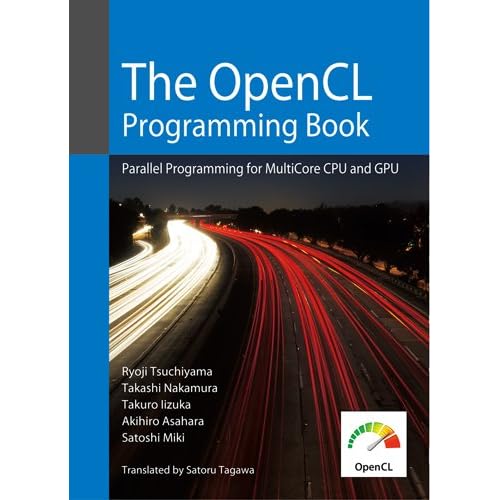
The OpenCL Programming Book
Publisher: Fixstars Corporation Author: Fixstars Corporation (Ryoji Tsuchiyama, Takashi Nakamura, Takuro Iizuka, Akihiro Asahara, Satoshi Miki)
Introduction to Parallelization
Why Parallell
Parallel Computing (Hardware)
Parallel Computing (Software)
Conclusion
OpenCL
What is OpenCL?
Historical Background
An Overview of OpenCL
Why OpenCL?
Applicable Platforms
OpenCL Setup
Available OpenCL Environments
Developing Environment Setup
First OpenCL Program
Basic OpenCL
Basic Program Flow
Online/Offline Compilation
Calling the Kernel
Advanced OpenCL
OpenCL C
OpenCL Programming Practice
Case Study
FFT (Fast Fourier Transform)
Mersenne Twister
Notes


Heterogeneous Computing with OpenCL
Benedict Gaster, Lee Howes, David R. Kaeli, Perhaad Mistry, Dana Schaa
  1. Introduction to Parallel Programming
  2. Introduction to OpenCL
  3. OpenCL Device Architectures
  4. Basic OpenCL Examples
  5. Understanding OpenCL's Concurrency and Execution Model
  6. Dissecting a CPU/GPU OpenCL Implementation
  7. OpenCL Case Study: Convolution
  8. OpenCL Case Study: Video Processing
  9. OpenCL Case Study: Histogram
  10. OpenCL Case Study: Mixed Particle Simulation
  11. OpenCL Extensions
  12. OpenCL Profiling and Debugging
  13. WebCL

Monday, June 6, 2011

AMD Radeon™ E6760 Embedded GPU OpenCL Compliant


AMD has released the first embedded GPU offering suport for OpenCL.
More information:

Why does NVidia not do the same for Tegra?

Anyway, let's create OpenCL HP applications for embedded systems.

Friday, June 3, 2011

Anjuta Project Wizards for AMD, NVidia and Intel OpenCL SDK

Aiming at increasing the OpenCL developing, I created some wizards to start up an OpenCL application project using the SDK from NVidia, AMD or Intel. I've used Anjuta DevStudio on Linux.

This is just a first approach, so don't be disappointed if you need to do some changes. The wizards give you a simple functional code and you can work on this one.

System requirements (they depend on your goal):

Monday, September 21, 2009

BLAS Library for OpenCL

I use the conjugate gradient solver without preconditioners to solve a linear system Ax=b, where A is a sparse matrix. This method is iterative and uses some BLAS functions like Dot Product, Scalar Product, xAXPY and xGEMV (SpMV for sparse matrix).I've started to develop these functions for the OpenCL language and I've decided to share them.

Right now, the following BLAS level 1 functions are available:
sDOT :: single precision dot product or scalar product (dot<-xy)
sNRM2
:: single precision vector 2-norm
sSCAL :: single precision product of vector by scalar (x<-ax)
sAXPY
:: single precision AXPY (y<-ax + y) You can download the OpenCL code which was tested on NVIDIA Tesla C870 and GPU Computing SDK 2.3

SourceForge Project

Please join up with your contribution!

Update: OpenCL BLAS now is a discontinued project.

Tuesday, April 21, 2009

First OpenCL demo

This demo of OpenCL on NVIDIA GPU was based on early non-released OpenCL API/driver interface. The nbody simulation shown was a simulation of massive particles under the influence of physical forces. Nbody simulation is known to be computationally intensive. The demo shows how OpenCL can deliver high performance computing using the parallel cores of the CUDA architecture on NVIDIA GPUs. This demo also illustrates the idea that core computational code can be written in OpenCL and will scale to whatever number of cores are available. The demo shown in Siggraph used the 32 parallel cores available on the NVIDIA Quadro FX 570M GPU that it ran on.

The first public demonstration of OpenCL running on a GPU was done by NVIDIA on December 12, 2008 at Siggraph Asia.


Monday, April 20, 2009

OpenCL and CUDA

NVIDIA's CUDA is, in my humble opinion, the most easy way to program GPU today. This little article guides you to write your first application on graphics processors from NVIDIA. I suppose that you have a good knowledge in C programming.


Step 1: Get CUDA
Download API

Step 2: Compile all the projects in ~/NVIDIA_CUDA_SDK/projects directory
do a make

Step 3: For testing only
execute deviceQuery

you can get a result like this:

There is 1 device supporting CUDA

Device 0: "Tesla C870"
Major revision number: 1
Minor revision number: 0
Total amount of global memory: 1610350592 bytes
Number of multiprocessors: 16
Number of cores: 128
Total amount of constant memory: 65536 bytes
Total amount of shared memory per block: 16384 bytes
Total number of registers available per block: 8192
Warp size: 32
Maximum number of threads per block: 512
Maximum sizes of each dimension of a block: 512 x 512 x 64
Maximum sizes of each dimension of a grid: 65535 x 65535 x 1
Maximum memory pitch: 262144 bytes
Texture alignment: 256 bytes
Clock rate: 1.35 GHz
Concurrent copy and execution: No

Test PASSED


Step 4: Writing your code
  • you should make a code for CPU(host program) and a code for GPU (kernel)
  • write a file named "firstcuda.cu", for example:

#include <stdio.h>
#include <cuda.h>

__global__ square_array(float *a, int N)
{

int
idx = blockIdx.x * blockDim.x + threadIdx.x;
if
(idx < N) a[idx]=a[idx]*a[idx];
}

  • above is the device part, now you should write the host CPU part.
// main routine that executes on the host
int main(void)
{

float
*a_h, *a_d; // Pointer to host & device arrays
const int N = 10; // Number of elements in arrays
size_t size = N * sizeof(float);
a_h = (float *)malloc(size); // Allocate array on host
cudaMalloc((void **) &a_d, size); // Allocate array on device
// Initialize host array and copy it to CUDA device
for (int i=0; i<N; i++) a_h[i] = (float)i;
cudaMemcpy(a_d, a_h, size, cudaMemcpyHostToDevice);
// Do calculation on device:
int block_size = 3;
int
n_blocks = N/block_size + (N % block_size == 0 ? 0:1);
square_array <<< n_blocks, block_size >>> (a_d, N);
// Retrieve result from device and store it in host array
cudaMemcpy(a_h, a_d, sizeof(float)*N, cudaMemcpyDeviceToHost);
// Print results
for (int i=0; i<N; i++) printf("%d %f\n", i, a_h[i]);
// Cleanup
free(a_h); cudaFree(a_d);
}


Step 5: Compile and execute
$ nvcc -o firstcuda firstcuda.cu
$ ./firstcuda


0 0.000000
1 1.000000
2 4.000000
3 9.000000
4 16.000000
5 25.000000
6 36.000000
7 49.000000
8 64.000000
9 81.000000


And about OpenCL?
OpenCL is under Khronos Technology responsability and it was initially developed by Apple and its purpose is to be is a framework for writing programs that execute across heterogeneous platforms consisting of CPU, GPU and other processors. NVIDIA promises GPU compatibility.

A little conversion from CUDA code to OpenCL is presented below:


__kernel void //kernel code
square_array(__global const int N,
__global float * a)
{
// work item index, cuda thread index
int idx = get_global_id(0);
if (idx < N) a[idx] = a[idx]*a[idx];
}


The host program contains a collection of compute kernels and internal functions.


#include <stdio.h>
#include <cl.h>

// main routine that executes on the host
int main(void)
{
float *a_h; // Pointer to host & device arrays
const int N = 10; // Number of elements in arrays
size_t size = N * sizeof(float);
a_h = (float *)malloc(size); // Allocate array on host

// Initialize host array and copy it to CUDA device
for (int i=0; i<N; i++) a_h[i] = (float)i;

// create the OpenCL context on a GPU device
cl_context context = clCreateContextFromType(0, // (must be 0)
CL_DEVICE_TYPE_ GPU, NULL, // error callback
NULL, // user data
NULL); // error code

// get the list of GPU devices associated with context
size_t cb;
clGetContextInfo(context, CL_CONTEXT_DEVICES, 0, NULL, &cb);
cl_device_id *devices = malloc(cb);
clGetContextInfo(context, CL_CONTEXT_DEVICES, cb, devices, NULL);

// create a command-queue
cl_cmd_queue cmd_queue = clCreateCommandQueue(context,
devices[0], 0, // default options
NULL); // error code

cl_mem memobjs[1];
// allocate input buffer memory objects
memobjs[0] = clCreateBuffer(context,
CL_MEM_READ_ONLY | // flags
CL_MEM_COPY_HOST_PTR,
sizeof(cl_float)*n, // size
a_h, // host pointer
NULL); // error code

// create the program
cl_program program = clCreateProgramWithSource(
context,
1, // string count
&program_source, // program strings
NULL, // string lengths
NULL); // error code
// build the program
cl_int err = clBuildProgram(program,
0, // num devices in device list
NULL, // device list
NULL, // options
NULL, // notifier callback function ptr
NULL); // error code
// create the kernel
cl_kernel kernel = clCreateKernel(program, “square_array”, NULL);

// set “a” vector argument
err = clSetKernelArg(kernel,
0, // argument index
(void *)&memobjs[0], // argument data
sizeof(cl_mem)); // argument data size

size_t global_work_size[1] = n; // set work-item dimensions
// execute kernel
err = clEnqueueNDRangeKernel(cmd_queue, kernel,
1, // Work dimensions
NULL, // must be NULL (work offset)
global_work_size,
NULL, // automatic local work size
0, // no events to wait on
NULL, // event list
NULL); // event for this kernel

// read output array
err = clEnqueueReadBuffer( context, memobjs[0],
CL_TRUE, // blocking
0, // offset
n*sizeof(cl_float), // size
a_h, // pointer
0, NULL, NULL); // events

// Print results
for (int i=0; i<N; i++) printf("%d %f\n", i, a_h[i]);

// Cleanup
free(a_h);
}


So, that is it. We don't have any OpenCL compiler yet, but it will arrive soon.